


Well, that was certainly a shock.
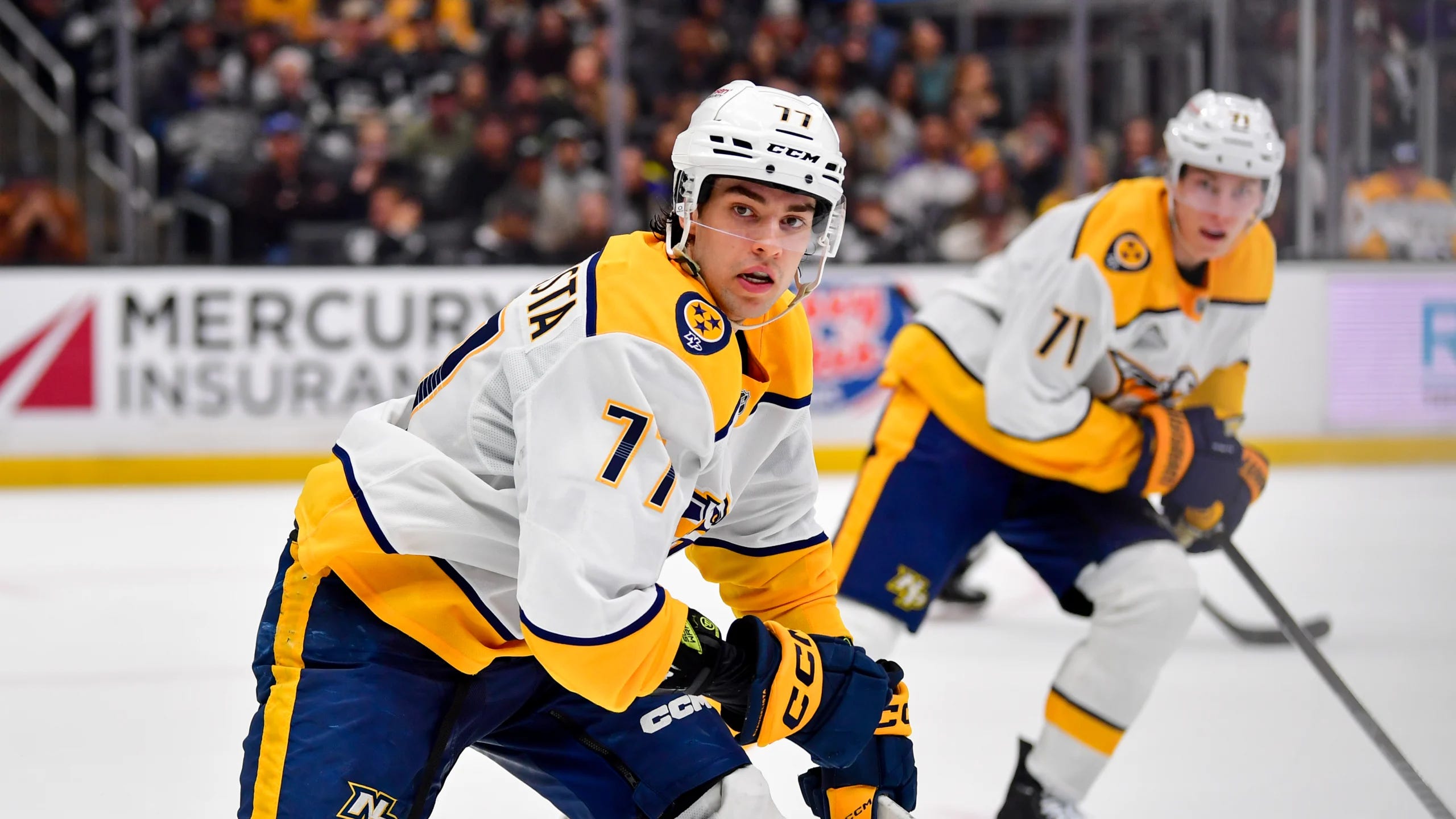
At 7:45 p.m. Central Standard Time, the Nashville Predators announced a move that hardly anyone saw coming, trading 24-year-old forward Luke Evangelista to the New Jersey Devils. In exchange, they received two draft picks: a conditional 2028 first-round pick that originally belonged to the Colorado Avalanche and a 2028 second-round pick.


The original post (and subsequent posts from beat writers and national analysts/insiders) drew a flurry of reactions. The Nashville side was, for the most part, filled with “why would you do this?” for one reason or another. The New Jersey side felt more like “I’m extremely intrigued by what this kid could do in arguably the best forward group in the National Hockey League.” There are always going to be doubters, but the general scuttlebutt was more about Evangelista’s potential.
And why wouldn’t it be?
If I’m a Devils fan today, I’m ecstatic about the player my team just acquired. And if I’m a Predators fan, I’m wholeheartedly confused. I’ll explain why.
Evangelista is a 24-year-old right-shot forward who is coming off a career season in 2025-26. He played in 81 games and tallied 12 goals and 44 assists for 56 points, the fourth-highest on the team; in those 44 assists, he led the team with 18 primaries. All of this came with just under half of his shifts starting in the defensive zone, too.
From a box score perspective, the Toronto, Ontario native was poised to continue his growth under head coach Andrew Brunette. However, it’s not just the box score that pointed to that. In fact, the underlying numbers point to Evangelista being one of, if not the best, players on a middling Predators squad last season, a fact that the new, analytically-minded general manager in Newark, Sunny Mehta, realized.
Evangelista was a stalwart in the Predators' analytics last season. He not only topped the charts in play-driving and holistic metrics, but he also performed well with predictive numbers.
In 2025-26, Evangelista finished with the second-lowest goals above expected according to MoneyPuck at -3.8 (only ahead of Fedor Svechkov), implying he deserved more goals (and more points) than he had by season’s end. With a team-leading 17 unblocked high-danger shot attempts, he was in consistent pursuit of high-danger opportunities. He also finished with the third-highest goals-for percentage (GF%) at 52.53%, behind Ryan O’Reilly and Filip Forsberg, and the highest expected goals-for percentage (xGF%) at 56.18% at 5v5. Below are some visualizations to drive the point home.
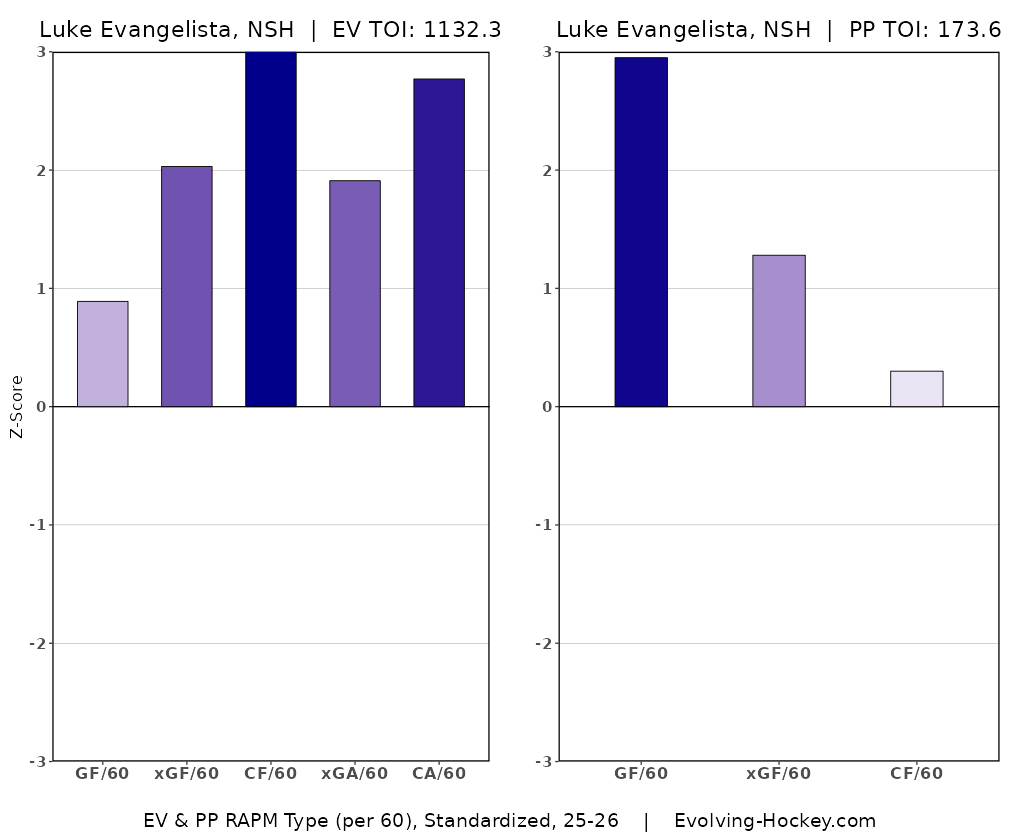
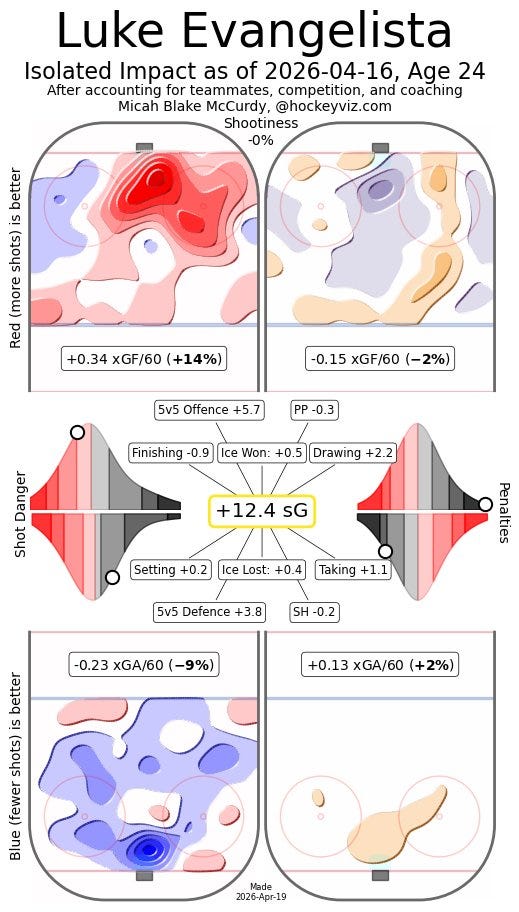
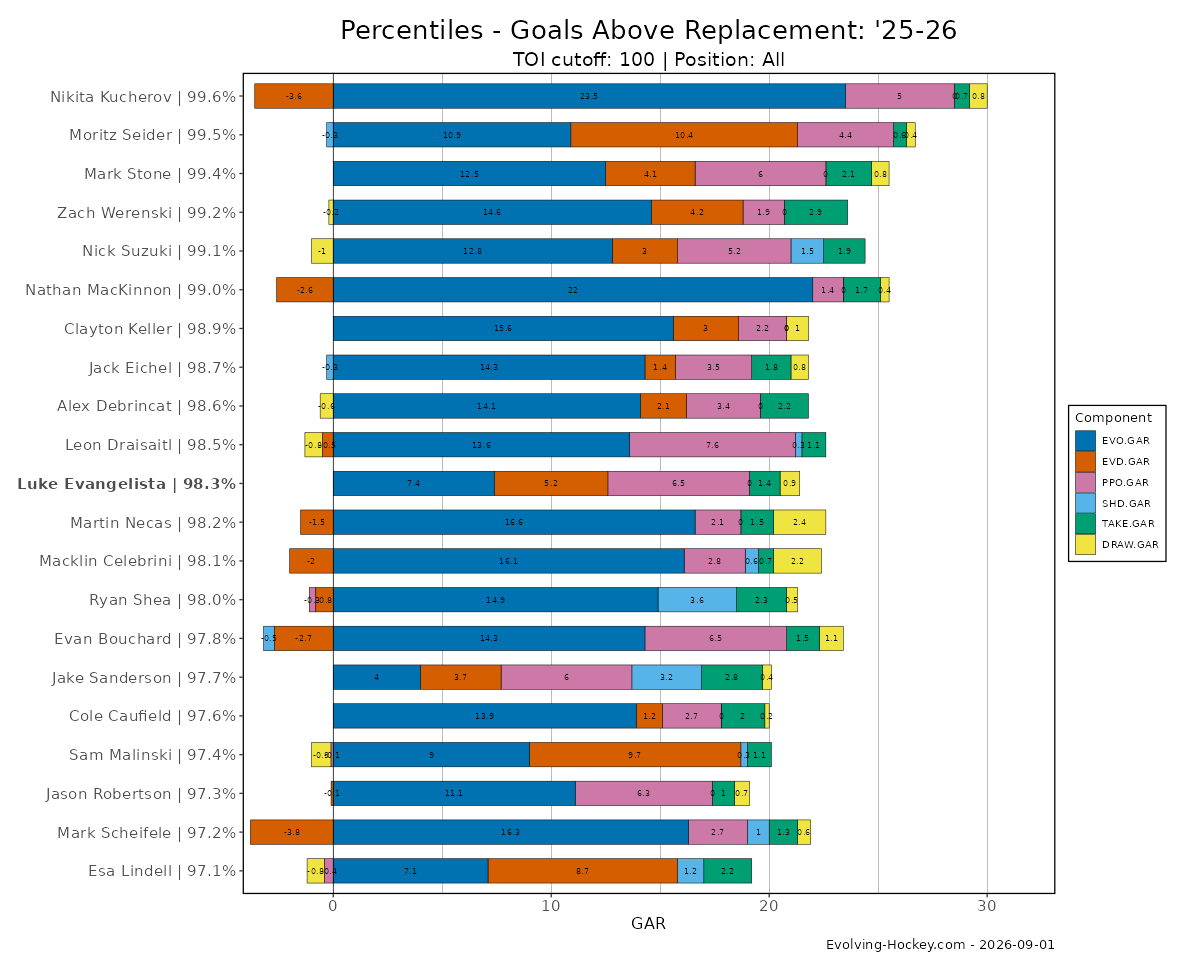
The charts above not only point to Evangelista being arguably the most impactful player on the Predators last season, but also one of the most impactful players in the entire NHL. And while some may make the argument that Evangelista was mostly deployed at 5v5 with Ryan O’Reilly (607:30 minutes with) and Filip Forsberg (401:31 minutes with), and that’s what led him to success, I’d argue it’s the other way around.
In those minutes with O’Reilly and Forsberg, Evangelista not only was great himself, but he made those two great as well. In O’Reilly’s case, he finished the season with a 63.33 GF% and a 59.41 xGF% with the 24-year-old on his right side. Without him? O’Reilly’s numbers dropped off significantly to 46.34% and 44.51% in those respective categories.
Forsberg’s story is a bit more complex in these departments, finishing the year with a 52.78 GF% with Evangelista and a better 55.36% without him. And why wouldn’t that make sense? He scored 40 goals and led the team in points. However, he also had the second-highest shooting percentage of his career, and the real disparity with Evangelista shows up when you focus on play-driving and generating high-danger chances. With Evangelista, Forsberg finished with a well-above-average 56.30 xGF%. Without him? 45.66%.
There are, of course, plenty of other numbers to rifle through, but the vast majority of them say much of the same: Luke Evangelista was not a byproduct of his surroundings, but rather a major catalyst on a middling team.
The argument from the other side of the table — the one that general manager Chris McFarland holds — is that there are an incredible number of wing prospects in their system already, so the Preds could make way for them by moving on from one who is obviously an excellent player but still part of the “old guard” of prospects.
Alex Daugherty of The Tennessean quoted McFarland as saying, "The depth of the winger market, the depth of our winger prospects, we feel we're very forward-heavy. We've got a lot of wingers that are going to wear our colors for the next few years..."
McFarland also made a note that Evangelista’s contract ending after the season (and him likely receiving a hefty raise, especially if he grows like he did last season) was not a factor in making the decision.
But it still doesn’t add up, and Predators fans have a right to be confused and ask questions until the vision plays out further. Why, after an offseason of directly hunting 24- to 29-year-olds with excellent underlying numbers on all fronts, would you trade the one who has proven himself to work in the system from the coach you’re inheriting, especially if his contract wasn’t a factor?
The Predators’ GM also mentioned the exorbitant number of right-hand-shot forwards as a reason for making the move. However, with consistent rumors about 35-year-old Jonathan Marchessault being traded (along with his career-worst season in 2025-26) and 36-year-old Steven Stamkos’ contract being up in two seasons, the question of ‘Why’ comes into play again.
Brady Martin was noted by McFarland following the trade and is waiting in the pipeline wings, but after just an average, injury-laden season with the Soo Greyhounds, it’s hard to believe he’s ready for a full-time gig in the show. And, most importantly, it’s a bit more worrying that he’s now labeled as a winger instead of potential depth at center, which is what he was initially advertised as coming out of the draft (and while Porter Martone lights it up as a true winger in Philadelphia). And Egor Surin, not a right-shot, won’t be with the Predators until 2027. Matthew Wood is the only viable current option, and while he seems poised to have a strong NHL career, he’s not nearly as dynamic a player as Evangelista is, and he can’t fill two roster holes at once.
Even with all of these prospects coming out of the woodwork to try and grab their NHL chance with the tightest grip, it’s a frustrating reality for Predators fans that, as soon as their franchise drafted and developed a forward prospect who made a sizeable impact at the NHL level, he was traded away for more drafting and developing. When calling for a rebuild, the idea wasn’t to trade away young, talented, and proven players for more rebuilding. Instead, the call was for systematically replacing older, ineffective players by acquiring younger, more effective forwards and futures. In McFarland’s credit, he has done a good job of that so far, and even this return for Evangelista isn’t “bad.” Rather, it’s just confusing.
The Predators now have to find a replacement for an Evangelista-sized hole in the top six, and with the season fast approaching, they need to do it fast or feel confident in the players on the roster right now. No one knows what’s next in the plan for the Predators front office, but there’s no doubt this trade will be talked about through the rest of the offseason and into regular season play.
