


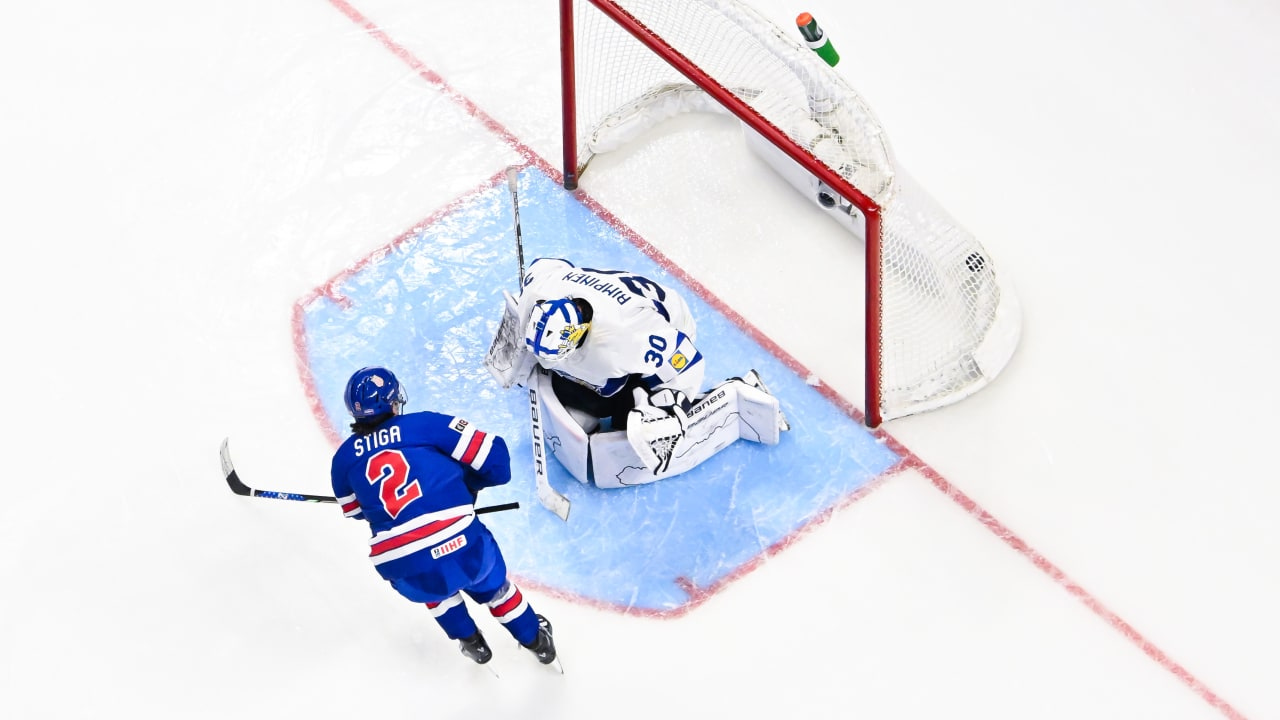
The midseason break is nearly here, which means the 2026 World Junior Championship (WJC) and the Spengler Cup are upon us. Below is a look at the Preds prospects playing international hockey this winter and expectations for their performances.
Daniel Nieminen | D | Pelicans (Liiga)
Drafted in the sixth round at the NHL Entry Draft this summer, Daniel Nieminen is playing in his second full season with the Finnish Liiga’s Pelicans. The blueliner has scored five points in 27 games this year and will return to the WJC for a second year. Last year, he notched two assists and finished fifth among Finland’s defenders in ice time.
Nieminen should log significantly more minutes this year, including time on Finland’s power play. I don’t expect the 19-year-old to take over any games for his home country, but he may chip in a goal or two and should provide ample set-up opportunities for his teammates.
The biggest question I have is how his one-on-one defense, bolstered by good skating, holds up against the world’s best prospects and how much Finland relies on him in crunch time.
Viggo Gustafsson | D | AIK (HockeyAllsvenskan)
Much like Nieminen, Viggo Gustafsson is returning to the WJC for Team Sweden after serving as a depth defender at the 2025 tournament (averaging just over ten minutes per game). There are four other NHL-drafted prospects on Sweden’s blue line, meaning Gustafsson will have to compete for top-four minutes.
He’s played 22 games in Sweden’s second-tier league this year, adding six assists but has struggled at times with his defense. He should fare better against players his age, but I don’t expect Gustafsson to be a major offensive contributor at this tournament.
I’ll be curious to see how much special teams ice time he gets, and if he shows more effective use of his frame when defending.
Teddy Stiga | F | Boston College (NCAA)
Team USA will have three roster cuts to make ahead of the tournament, but Teddy Stiga is a lock to play in Minnesota—especially after scoring the golden goal in 2025. The 2024 second-round pick will feature prominently on the United States’ offense after posting three goals and 11 points in 15 games with Boston College (BC) this season. I’d expect Stiga to skate alongside BC teammate James Hagens for much of the tournament and to ultimately be one of the team’s forward leaders in ice time.
Stiga will likely chip in more assists than goals, but it’s reasonable to expect he finishes as one of the United States’ top scorers as they chase a third-straight title.
I’ll be watching how Stiga gets used on Team USA’s power play and if he can be more of a dual-threat producer than just a playmaker.
Ryker Lee | F | Michigan State Univ. (NCAA)
Ryker Lee is the 2025 draft pick I’ve been most impressed with to date; he’s recorded a primary point on 60 percent of the even-strength goals he’s been on the ice for. The first-round pick faced significant questions about his skating heading into college but has adjusted better than expected and forced his way into more ice time and responsibility at one of the nation’s best programs.
Despite not being a roster lock, I’d be pretty shocked if Lee is cut from Team USA’s roster before the tournament later this month. He provides significant depth scoring and is a unique weapon on the power play.
I wonder how much the coaching staff’s trust in him grows over the course of the WJC and how lethal he can make the U.S. on the man advantage. If he proves he can stick with the big names, he may be deployed in critical situations in the medal rounds.
Brady Martin | F | Soo Greyhounds (OHL)
After starting the year in the NHL, Nashville’s prized prospect from the 2025 NHL Entry Draft has returned to junior hockey and posted 16 points in 13 games for the Soo Greyhounds. Despite the point totals, I don’t feel as if Martin has been truly dominant since heading back to the OHL. However, I think the WJC is a good opportunity for him to capitalize on the second half of his season.
Team Canada’s practice lines have shifted each day, but Martin has been getting a long look in the top six alongside 2026 first-overall hopeful Gavin McKenna. This roster, like most years, is stacked, and it can be difficult for prospects to stand out. But Martin took over the U18 WJC last year, and he may be put in a position to do something similar this year.
I don’t know if we’ll see a ton of Brady Martin on the power play, but I wonder if he gets much penalty killing time. Additionally, should Canada face adversity, I’ll be watching to see how Martin factors in to any line juggling or shifting responsibilities.
Cameron Reid | D | Kitchener Rangers (OHL)
After a slow start to the year, Cameron Reid is up to nine goals and 29 points in 28 games with the Kitchener Rangers, including 12 points in his last 10 games. The blueliner is fifth in defender scoring in the OHL and joins a stacked Team Canada back end.
It’s hard to say where Reid will line up on Canada’s blue line, but I expect he’ll average top-four minutes. He may not quarterback either of their power play units, but the first-round pick is an excellent skater with valuable possession skills. So far in practice, he’s lined up alongside Zayne Parekh (Calgary) on pair number one and Jackson Smith (Columbus).
Reid should rack up a few assists as the tournament goes on, but I’m curious to see how much Canada uses him in a shutdown role and if he separates himself from the pack after the round robin portion.
Jack Ivankovic | G | Univ. of Michigan (NCAA)
Jack Ivankovic has been the best goalie in college hockey this year. He’s recorded a 0.927 save percentage in 20 games and stopped 9.229 goals above average as Michigan maintains the top spot in the nation’s rankings.
Despite all that, the competition for Canada’s starting goalie spot is fierce, featuring Carter George (Los Angeles) and Joshua Ravensbergen (San Jose). The only real question facing Ivankovic is: Can he win the starting job? I expect there to be some rotation in the round robin, but will he be Canada’s guy come the medal round?
Aiden Fink | F | Penn State Univ. (NCAA)
Aiden Fink won’t be joining Team Canada at the WJC, but he will be representing a different squad at the Spengler Cup. The Spengler Cup has been around since 1923 and is an annual invitational hosted by the Swiss club HC Davos. Over the years, the competition has featured international teams, European pro clubs, college teams, AHL teams, and more; this year’s tournament will be played between Davos, HC Sparta Praha (Czechia), IFK Helsinki (Finland), HC Fribourg-Gottéron (Switzerland), a Canadian national team, and, for the first time, an NCAA all-star team.
Fink, who’s in his third season with Penn State, will help lead that NCAA team. After breaking the 50-point threshold last year, Fink had a relatively slower start to his junior campaign with two goals and nine points in nine contests. The Nittany Lions have had some major losses despite their influx of talent like Gavin McKenna and Jackson Smith, and Fink’s line just hasn’t totally clicked. He’s been on the ice for just five even-strength goals but has a primary point on four of them.
Unfortunately, Fink has been out of the lineup since October with an upper-body injury. Nothing has indicated Fink won’t be ready for the tournament, but that’s to be determined.
If he suits up, this will be a decent test of how the undersized Fink lines up against pro players. It won’t tell us everything, but if his offense can break through, that could be telling as he eventually progresses to the AHL.
Jakub Milota | G | Blainville-Boisbriand Armada (QMJHL)
Jakub Milota has played just three games in the QMJHL this year due to multiple injuries, including being shelved since October with a lower-body ailment. He was initially named to Team Czechia’s roster and expected to start in net, but he’s still recovering and will miss the WJC.
