


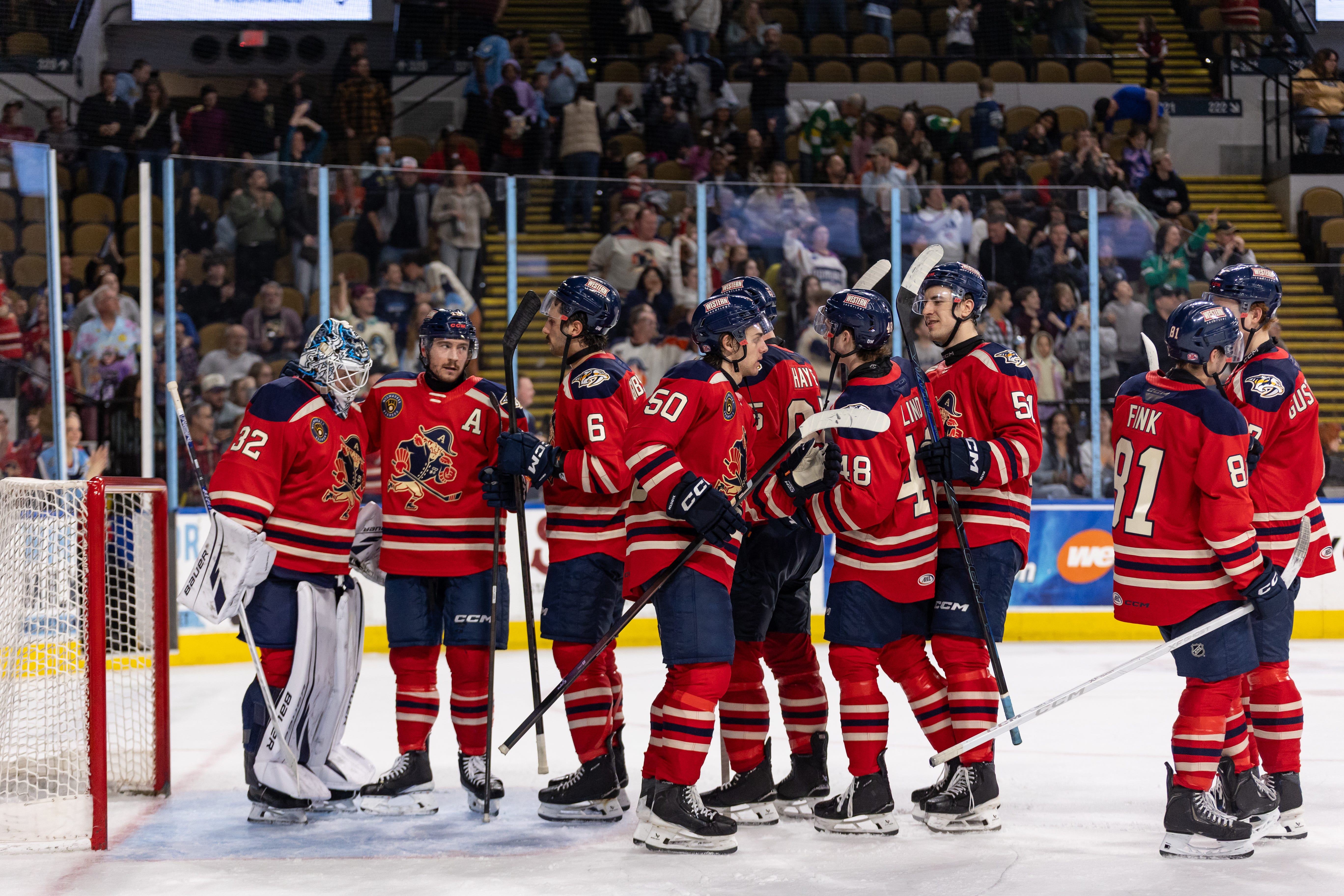
The Milwaukee Admirals begin their Calder Cup push today in an expanded playoff field featuring 23 teams. Since joining the AHL in 2001, the Ads have missed the playoffs three times in a normal season; if the league hadn’t expanded the playoff field, they would have missed it by 13 points this year.
Only once before have the AHL Admirals finished a regular season with a sub-0.500 record: the 2001-02 season. This year, they finished at 0.493.
They’ll face the Manitoba Moose in a best-of-three play-in series, and if they win, they’ll face Grand Rapids. It would be ironic if—after years of regular-season dominance and playoff sputters—this is the year the Admirals win the Calder Cup. But regardless, what do this season’s struggles tell us about the future of the Nashville Predators?
First and foremost, it’s time to clean house. Not necessarily with the roster but with the coaching staff and front office. I generally like Karl Taylor. He’s a smart coach who gets a lot out of his players. But after eight years at the helm in Milwaukee, maybe his shelf life is up. Despite his AHL success, Taylor has not been able to break through on NHL radars, and the Admirals—who invest equally in winning and development—have reached the conference finals just three times since their Calder Cup win in 2004.
With a new general manager coming to Nashville, it’s time to move on from Scott Nichol as well. Nichol has served as Milwaukee’s general manager since 2018-19 and Nashville’s Director of Player Development since 2013-14.
By the Predators’ measure of success, Nichol has done an excellent job. Baked into his DNA is this organization’s modus operandi: draft for character, develop for grit and tenacity, and ignore the need for game-breakers. In more than a decade, Nichol has developed just three 50-point scorers (an extremely low bar) through Milwaukee: Filip Forsberg, Viktor Arvidsson, and Luke Evangelista. That cannot be an acceptable standard in the modern NHL.
I’ve thought a lot about Nashville picking Brady Martin over Porter Martone last summer as the latter shines in the NHL playoffs. I’m not yet worried about Martin—and the team has taken some recent swings at skill (Lee, Surin, Wood, Kemell, etc.)—but years of conservative drafts and an emphasis on depth, replaceable players in the farm system have left this franchise in no man’s land. Frédérick Gaudreau, Colton Sissons, Mathieu Olivier, Yakov Trenin, Cole Smith, and more have all been AHL darlings and carved out successful roles in the NHL, but there’s a reason they’ve all been traded out of Nashville. I suspect the likes of Reid Schaefer and David Edstrom are headed down a similar route.
Despite that, the Admirals iced some exciting offensive talent this year. I like Fedor Svechkov, Zach L’Heureux, Cole O’Hara, and Aiden Fink, and I still believe Joakim Kemell can make an impact in the NHL. But each of those prospects reinforces how desperate Nashville is for game-breaking talent. No one in the pipeline is a threat to score 100 points in the NHL; none are a threat to chase a scoring title, and none elevate this organization to the upper echelon of the league. Together, these prospects are a decent NFL roster with absolutely no quarterback.
On the back end, while Barry Trotz has repeatedly boasted about the size of the organization, Milwaukee has shown that the next general manager should focus on something else. Mobile, offensive blue liners are taking over the league: Bouchard, Makar, Hutson, Hughes, Schaefer, etc. The modern NHL doesn’t just require three-plus scoring lines; you need dynamic point producers on the blue line, too. If you look at the 2026 NHL Draft class, you see the same thing: Chase Reid, Carson Carels, Keaton Verhoeff, etc. Roman Josi does not have many years left, but the Admirals can develop something positive in Ryan Ufko, Tanner Molendyk, and maybe even Daniel Nieminen.
If the Admirals under- or overperform in the playoffs, it won’t matter much. But the new brass in Nashville must use this opportunity to set a new tone and catalyze this organization out of its just-good-enough attitude and persistent mediocrity. There are enough pieces in place to build a highly competitive organization, but the new brass must be willing to make hard decisions to push both the NHL and AHL teams forward.

When I read this the first thought that came into my mind was Adam Vingan wrote this... as it is his 'style' to 'bash' and 'put down' good things that 'are' and 'might be' so he can get an opinion out to 'stir up a hornet's nest'. Why the bashing? If your roster was decimated by having your 'star' players called up to the NHL what would you think would happen? Any better than what did is unrealistic. So, now instead of getting rid of the Preds coach and GM we are going to 'tunnel' our emotions down to 'the farm'. Get a life! Stop being like the 'mainstream media' and writing stories with the 'if it bleeds let it lead' concept. Wouldn't it be a kick in your pants if Karl Taylor was called up to the Preds as either an assistant or as head coach. #LetTheKidsPlay these playoffs in MWK and let's try speaking positive vibes [1st concept in the Bible.... God said and it happened] and speak the Admiral's into a long, positive playoff experience. MWK is re-tooling and with all the Preds draft stockpile will develop once again. Read here if you want what your story should have said: https://www.nhl.com/predators/news/admirals-ready-to-begin-ahl-playoffs-with-familiar-preds-faces-2026-04-22 Have a good day... BTW, don't apply for a GM job anywhere if your story is how your mind thinks.